"I got into an accident and was nervous about finding a personal injury attorney after hearing so many awful stories, but from the start, I felt confident with my choice in Kaplan Law, LLC." Read More - Ben
"Matt and Gillian took great care of me during a stressful time of my life. Very caring and knowledgeable group. I would definitely recommend Kaplan Law!" Read More - Kayleigh
"Incredible service and results! Matthew Kaplan and his paralegal Gillian did an amazing job for me. Not only did they resolve my case beyond my satisfaction, they also were very caring and supportive thru my recovery. I couldn't ask for a better attorney." Read More - Jamal
Matthew D. Kaplan

SafeKids Oregon – an organization that regular readers will know I have long supported – has just published a very useful set of back-to-school tips and reminders. They are worth the attention of every Oregon parent.

The group’s website offers a useful guide focused on preventing injuries to children by teaching them how to walk safely to school. The publication, “Teaching Children to Walk Safely as They Grow and Develop” usefully offers varied advice for parents of kids in several different age groups. Key points include teaching younger children “where to cross streets and how to cross safely.” With older kids – especially kids who may have their own cellphones or other attention-absorbing electronic devices – the group notes that “attention-switching and concentration skills are essential.”

At every age the important thing is not only that skills are learned but that children have the opportunity to reinforce them. As the group notes, “children will demonstrate these skills some of the time, so continued practice is needed until they are consistent.”

A summer marked by low gas prices has led to a jump in the number of miles Americans are driving. Unfortunately, it also appears to be leading to a significant increase in traffic deaths, according to a recent Yahoo! News article.

“The National Safety Council reported this week that traffic deaths and serious injuries in the US are on a pace to rise for the first time in nearly a decade. If the trend for the first six months of this year continues, the NSC says traffic fatalities in the nation will exceed 40,000 for the first time since 2007 and deaths per 100 million vehicle miles traveled will also increase,” the news service reports. The key lies in the last part of that sentence – indicating that the number of on-road deaths is not merely a function of the greater number of miles being driven. The article notes that when compared to 2007 the number of mile Americans drive has increased by 3.4% but in the first six months of 2015 alone the number of traffic fatalities has jumped by 14%.

According to the article a number of factors contribute to this – such as higher speed limits – but one might also think that the steadily improving safety gear in modern cars and trucks would, at least to some extent, mitigate that. The big thing that has changed for the worse, according to the study, is the steady rise in distracted driving in general and cellphone use in particular despite laws and educational campaigns here in Oregon and elsewhere designed to curb the practice. From a legal perspective this is especially significant since it, in turn, means that an increasingly large number of drivers are placing themselves at risk of wrongful death charges in the event of an accident.

NBC news is reporting this weekend that Britax, a major manufacturer of child car seats, “is recalling 37 models of its car seats due to a potential safety defect that could prevent harnesses from locking.”

In a web article the news organization reports that the recall order effects models built between August 1 of last year and the end of last month. The seats in question “may have a defective harness adjuster button that stays in the ‘release’ position when the harness is tightened, rendering the seat useless.” NBC adds that up to now no injuries to children have been reported as a result of the defect.

For its part, the company’s product recall page (see link below) offers detailed information on how to locate the manufacture date and serial number on Britax car seats and then use those to determine whether or not a particular seat is included in the recall order.

As the Bend Bulletin notes in a recent article, two recent crashes near the Central Oregon city are drawing attention to safety issues on US-97. The newspaper notes that just on Tuesday of last week two Oregon car crashes took place on the same stretch of the road highlighting an area that “has long been considered perilous for its intersections and lack of median barriers.”

The paper reports that an elderly man visiting from the Midwest was involved in a head-on crash Tuesday morning when he “tried to turn north from a private driveway on the southbound side” of the road. No one suffered life-threatening injuries in that particular Oregon car crash, but later in the day a six-year-old girl was critically hurt and seven other people suffered less serious injuries “when a Redmond woman traveling southbound crossed into the northbound lanes” in the same area of Highway 97.

Both of these accidents involved cars, but the heavy presence of semi-trucks along this stretch of road is a reminder that even more serious accidents can and do take place when larger vehicles are involved.

The Consumer Product Safety Commission has issued a recall notice regarding millions of dressers sold by furniture giant IKEA, announcing last week that the company is offering free repair kits to customers.

According to the CPSC notice (see link below) “the chests and dressers can pose a tip-over hazard if not securely anchored to the wall.” The danger of injuries to children is especially acute from this defective product. The models effected are the “MALM 3- and 4-drawer chests and two styles of MALM 6-drawer chests… about 7 million MALM chests and 20 million other IKEA chests and dressers are part of the nationwide repair program.”

The recall follows reports of two children’s deaths after IKEA dressers tipped over on them. The agency notes that “consumers should immediately stop using all IKEA children’s chests and dressers taller than 23-1/2 inches and adult chests and dressers taller than 29-1/2 inches, unless they are securely anchored to the wall.” As part of the recall IKEA is offering free wall anchoring kits to consumers.

US car makers may no longer dominate their industry they way they did a generation or two ago, but, as the New York Times recently detailed, their political clout in Washington remains formidable. As a result, the industry enjoys protections for unsafe and irresponsible behavior that other industries do not even when it results in auto accidents here in Oregon and elsewhere.

The newspaper reports that “legal loopholes that the auto industry helped create” are complicating efforts to hold both the auto makers and individuals working for them accountable for defective products they sold to millions of Americans over a period of years – products that led to many deaths and injuries.

“In one prominent example, lobbyists and trade groups blunted a law requiring car companies to notify regulators of certain safety defects within five working days, persuading Congress to water it down so that it carries only civil penalties, not criminal liability,” the paper notes. The article goes on to outline sensible proposals for accountability put forward over the last several decades by Republicans and Democrats alike, all of which have been eliminated or gutted in final legislation. It notes that “other industries, like pharmaceuticals and food” do not enjoy similar protections.

A report on the public radio program Marketplace this week focused on yet another way that our city is becoming a leader in promoting cycling. According to the report, a locally-based tech entrepreneur “has created an app called Ride, which asks cyclists to collect data as they cruise around Portland. The data will then help the city plan better cycling infrastructure, like signals, lanes, safer routes and where to avoid traffic.”

The report notes that around six percent of Portlanders use bikes to travel to and from work, a figure far above the national average of one percent. More dramatically, “that number leaps to 25 percent in the inner city.” Combine this with almost 350 miles of bike infrastructure in and around Portland and our city is uniquely well-equipped to help people improve both their health and the environment by replacing cars with bikes.

Unfortunately, Portland bicycle accidents involving traffic remain far more common than they should be. The hope is that by collecting a constant, and far more accurate, stream of data those accidents can be curbed – something that would benefit everyone.

A party line vote in the Senate Commerce, Science & Transportation Committee this week marked a big win for industry lobbyists and loss for consumers. According to a report in the Washington Post the approved legislation, which now heads to the full Senate, “brims with industry-sought provisions that would block, delay or roll back safety rules.”

The newspaper’s account focuses in particular on auto and rail safety. According to the Post the bill “would block a new Department of Transportation rule requiring that trains hauling crude oil are equipped with electronically-controlled brakes that affect all cars at the same time.” It would also delay rules requiring both freight and passenger trains to have “positive train control” safety systems, despite the fact that most observers believe the recent fatal Amtrak crash near Philadelphia could have been avoided if a PTC system had been in place on the train in question.

On our roads, the bill would roll back measures intended to curb car accidents here in Oregon and around the nation by increasing the size of the fines the National Highway Traffic Safety Administration can assess against auto makers. Those fines are currently capped at $35 million – a relatively small sum for any big global carmaker – at a time of record-shattering auto recalls. The NHTSA had sought the authority to levy fines of up to $300 million, believing that the higher number would give car companies more incentive to put safety first. The committee reduced that to $70 million.

A Harrisburg car crash over the weekend left a 19-year-old man dead and has led to the arrest of the vehicle’s 20-year-old driver, according to The Oregonian. “Police said alcohol and drugs likely were contributing factors. There was evidence to show that the driver… was allegedly (had) over twice the legal limit of alcohol (in his bloodstream) and had used cocaine and marijuana,” the paper reports.

Citing local police, the paper reports that the driver failed to make his way around a curve on a road in Linn County causing his minivan to roll several times. Of the three passengers in the van one was ejected and thrown some 50 feet. He was pronounced dead at the scene. The driver and the other two passengers, both of whom are 18 years old, were treated for “non-life threatening” injuries at an area hospital.

After his release from the hospital the driver “was booked into the Linn County Jail on charges of Manslaughter I, Assault II and DUII,” the newspaper reports.

A blog post this week from Bike Portland contained some good news for all of us concerned about bike and car accidents here in the city: “After more than a year of focused activism… one of Portland’s highest-traffic neighborhood greenways has been chosen as the site of a traffic calming pilot project.”

The announcement referred to Clinton Street where, it said, Portland will soon begin building a series of “diverters, speed bumps and signage” designed to slow down traffic in an area that a city study found “has some of the higher auto traffic volumes and speeds in the neighborhood greenway system” according to Bike Portland.

The group notes that “Diverters are already used on many neighborhood greenways to allow foot and bike traffic while blocking car traffic at certain intersections, preventing it from being useful to non-local car traffic.” (if you are unsure what exactly a “diverter” is click on the link below and look at the photo accompanying the article)

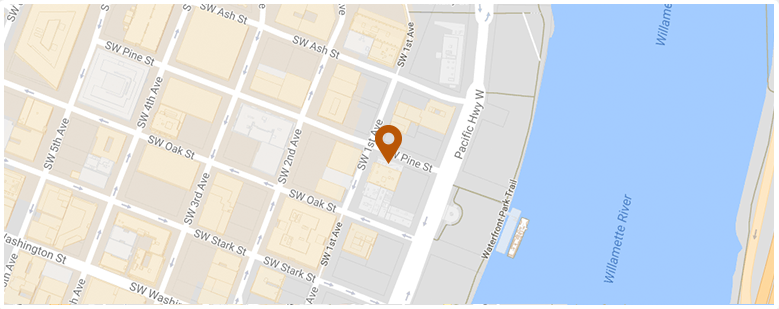
50 SW Pine St 3rd Floor Portland, OR 97204 Telephone: (503) 226-3844 Fax: (503) 943-6670 Email: matthew@mdkaplanlaw.com
map image