"I got into an accident and was nervous about finding a personal injury attorney after hearing so many awful stories, but from the start, I felt confident with my choice in Kaplan Law, LLC." Read More - Ben
"Matt and Gillian took great care of me during a stressful time of my life. Very caring and knowledgeable group. I would definitely recommend Kaplan Law!" Read More - Kayleigh
Matthew D. Kaplan

An important decision announced yesterday by the Oregon Supreme Court bolsters both the principle of openness in our court system and the idea that a key function of the courts is to enforce accountability.

According to the New York Times a unanimous ruling by the Oregon Supreme Court “cleared the way… for the release of thousands of pages of documents detailing accusations and investigations of sexual abuse or other improprieties by Boy Scout leaders around the nation from the mid-1960s into the 1980s.” The documents, which the Scouts’ leadership referred to as “the perversion files” were the keystone of the 2010 sexual abuse case that focused national attention on the organization. The organization was fined over $18 million because of its efforts to cover up the abuse of young boys rather than reporting it to authorities.

It is sad to see that even now the Scouts seem more concerned about protecting their organizational reputation than they are about the many injuries to children enabled by their decades-long conduct. As described by the Times, the files “were kept as a way of weeding out bad leaders and preventing abuse” but proved to be especially damaging to the organization because they offered proof that the Scouts’ leadership knew of cases of sexual abuse but did nothing to bring the guilty adults to justice.

Last week a graduating University of Oregon senior was sentenced to three years in prison for the Eugene drunk driving death of a fellow student, according to the Eugene Register-Guard.

The victim, a Scot who was also attending UO, was riding his bike in a marked bike lane when he was struck from behind. The newspaper reports that in the immediate aftermath of the Oregon bike and car accident the 22-year-old driver stayed with the victim “and took responsibility for his conduct.” The driver “had a blood alcohol level about twice that in which a driver is presumed intoxicated under Oregon law,” the paper notes.

The fact that the driver did not leave the scene of the accident and had no prior drunk driving history prompted prosecutors to agree to the lesser charge of criminally negligent homicide, rather than seeking a conviction for second-degree manslaughter (which would have carried a heavier mandatory sentence). The driver pled guilty as part of the agreement with the prosecutor’s office. He will also lose driving privileges for the remainder of his life.

National attention has been focused this week on a Massachusetts teenager convicted on charges of motor vehicle homicide in a case related to distracted driving. The teenager maintained his innocence, claiming he was distracted by worries about his homework load but not by his phone, according to a report by ABC News.

Prosecutors, however, used the 18-year-old’s phone records to prove that he had been sending and receiving text messages moments before his car swerved across the center line, striking an oncoming pick-up truck driven by a “55-year-old father of three.”

If we look at how this case might have played out under the laws in place here in Oregon several noteworthy things spring to mind. The Massachusetts case was a criminal trial. Though there are no reports of alcohol being involved in the crash, here in Oregon a civil case stemming from an accident like this would be similar to a DUII action. Oregon law would allow victims and their families to file claims for medical bills and lost wages and for the loss of the society and companionship of the deceased.

Depending on how one looks at it, the view expressed by automakers in a recent New York Times article represents either a resigned but forward-looking attitude toward electronics and driving, or a bid to maximize profits with little regard to the dangers of distracted driving here in Oregon and elsewhere across the nation.

According to the newspaper, the car companies are moving forward with plans for “connecting smartphones to in-dash systems and putting internet-based information into so-called connected cars for 2013.” It notes that while ever-more-elaborate electronic dashboards have been a fixture of our cars for some time, the newest car models will allow drivers to buy movie tickets, check restaurant reviews and make, read or listen to Facebook posts all while attempting to cope with all of the other distractions one encounters behind the wheel.

The government is concerned, the Times reports, noting that the National Highway Traffic Safety Administration “issued a 177-page set of proposed guidelines for in-car electronics” earlier this year. “The report repeatedly mentioned the complexity of dashboard displays,” it adds.

A recent article in the Sacramento Bee is a telling reminder of the importance of workplace safety here in Oregon and of the sort of precautions businesses ought to be taking to avoid Oregon industrial accidents.

According to an Associated Press report posted on the newspaper’s website, a 60-year old man’s arm was severed by an industrial lathe while he was working at GE Aviation Systems, a company which manufactures parts for airplanes. Quoting local first responders the news agency reports that “workers were turning a piece of metal and the man’s arm somehow got caught in the lathe.”

The victim was transported to a local hospital “along with his crushed arm. It’s unclear if the arm can be reattached,” according to the report.

The death of an avid cyclist in a Portland bike and car accident earlier this month has turned a spotlight on bike boxes – the green areas at intersections that the city began adding several years ago in an effort to make Portland more bicycle-friendly.

As I noted last week, a 28-year-old Portland woman died in an Oregon bike accident when she was struck by a semi-truck making a right turn from Madison onto Third Avenue. A recent article on KGW’s website noted that there is a bike box at that intersection, and that accidents like these are exactly what the bike boxes are designed to prevent.

“The green boxes painted in the road with a white bicycle symbol inside are located at several intersections around Portland to help prevent bicycle-car collisions, especially between bikes going straight when cars turn right,” the station reports.

As we head into the long holiday weekend – with the summer months stretching out ahead – it is appropriate to take a moment today to mark “Missing Children’s Awareness Day,” so designated by the federal government.

May 25 was chosen as Missing Children’s Awareness day nearly 30 years ago – in 1983 – in memory Etan Patz, the six-year-old New York City boy who disappeared while walking to his school bus stop in 1979. The anniversary is especially poignant this year because just yesterday a man in New Jersey came forward and confessed to Patz’s long-unsolved death. Today, the day chosen in Etan’s honor, he was charged with murder in a New York court. There could hardly be a more poignant way to mark this year’s Missing Children’s Awareness Day.

According to radio station KUIK, Oregon’s state records show that as of late last month 464 children were listed as missing here in our state. The radio station, citing state law enforcement sources, reports that of the children on that state list “about 90% are runaways.” Injuries to children are a constant worry for many parents, but the added burden of fearing for a child’s day-to-day safety while having little or no idea where to find them is something no one should ever have to go through.

A lawsuit filed in Alaska by the grieving families of five fishermen targets an Oregon company for alleged wrongful death according to a report published yesterday in the Anchorage Daily News. Two of the five victims were also from Oregon, according to the newspaper.

The newspaper, quoting Alaska state troopers, reports that the five men drowned earlier this month when their “overloaded skiff swamped… in rough seas” near Cook Inlet, Alaska. The men were harvesting clams for the company. The suit says that the company “failed to train the men to pilot their aluminum skiff and neglected to provide proper safety equipment such as survival suits and two-way radios.” Notably, the newspaper says that when the men’s bodies were recovered only one of the five was wearing a life jacket. It adds that “the wrongful death suit claims the workers needed survival suits, not life vests, to survive in the Inlet,” referring to the cold seas off Alaska’s coast.

Tellingly, the paper reports that another worker told investigating troopers that he believed the boat was overloaded, particularly granted the windy conditions prevalent in the area, and refused to get aboard. Among the charges made in the suit is the claim that Clackamas-based Pacific Seafood did not give its workers sufficient training in “water-safety rules, emergency life-saving lessons or how many pounds of clams the skiff could safely carry.”

Tragedy struck the Oregon bicycling community this week when a 28-year-old woman died after a Portland bicycle accident in which she was hit by a semi-truck. According to The Oregonian, the Portland truck accident took place last Wednesday evening as “the truck was making a right turn from Madison onto Third Avenue “ when it hit the cyclist, “who was traveling eastbound on Madison,” the newspaper reports.

The cyclist was transported to an area hospital following the accident, but died of her injuries the next day. The newspaper also reports that both police and the Multnomah County District Attorney’s office are investigating the fatal Oregon bike accident.

Accidents like these are the saddest sort of reminder how important road safety is for cyclists and drivers alike. The circumstances of this accident are also telling. A vehicle, especially a large one, is arguably most dangerous to cyclists when it is making a right turn. Drivers are keenly aware of traffic around them when turning left, because this generally involves crossing a stream of oncoming traffic. Right turns, however, are all too easy to think of as essentially ‘safe.’

The Oregonian reports that a Portland auto accident involving a car and a Tri-Met bus recently sent two people to the hospital with what authorities described as “minor injuries.”

Citing a spokesperson for the Portland-area bus service, the newspaper reports that the accident recently occurred “at Southeast 7th Avenue and Southeast Taylor Street. She said the vehicle, carrying three people, is believed to have been traveling at a high speed when the driver failed to stop and struck the bus on its left side.”

Both of the injured people transported to hospital were traveling in the car. The bus driver was not injured and the bus, which was traveling to a Tri-Met garage at the time of the Oregon car and bus accident, was carrying no passengers. That last fact is fortunate: it is likely that the lack of passengers minimized the potential damage from the Portland car crash.

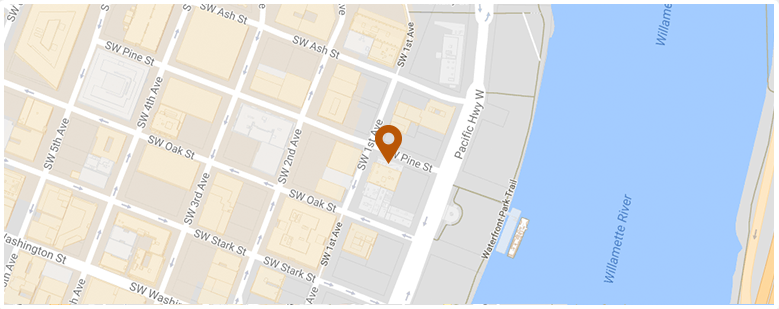
50 SW Pine St 3rd Floor Portland, OR 97204 Telephone: (503) 226-3844 Fax: (503) 943-6670 Email: matthew@mdkaplanlaw.com
map image