
Articles Posted in Injuries to Minors

Problems at a Portland-area foster care facility have brought wider issues surrounding the state’s child care system to public attention, including making it the focus of a recent state senate committee hearing. According to a recent article in The Oregonian “the issue flared… when the Senate’s human services committee confronted the Department of Human Services over accusations that a publicly-funded foster care agency abused or neglected children with little apparent oversight from state officials.”

Charges included the withholding of food, use of force with the children and unclean and unsafe conditions in some facilities. The newspaper notes that state officials stopped sending children to one particular facility in North Portland last month, but also raised broader questions about the system as a whole. More legislative hearings are expected in the coming months and several investigations are now underway. In addition, a former employee of the facility accused colleagues of altering reports and other data to conceal the wrongdoing. The director of the facility also appeared before the committee, where she denied all of the accusations.

According to the newspaper, state officials claim that 83 percent of the children in foster care receive a visit from a state worker each month. As this case demonstrates, however, that simply is not good enough. Injuries to children in the Oregon foster care system are far more likely to occur, and will be far more difficult to prevent, as long as both public and private foster homes are able to operate with so little supervision.
Laundry ‘pods’ – essentially pre-packaged detergent that can be thrown in the machine with no need to measure it – have only been around for a few years but have quickly become popular here in Oregon and across the country. As a recent story on MyCentralOregon.com details, however, they also pose a significant risk of Oregon injuries to children – a risk critical enough that the industry is being forced to take note.

According to the website “after tens of thousands of calls from frightened caregivers to poison control centers across the country” the products are being remade. The site reports that according to the American Association of Poison Control Centers there were nearly 12,000 incidents involving laundry pods and children age six or younger last year. This year there were 7,184 such incidents through July – a figure that puts the country on pace to surpass that shocking 2014 number.

As a result Consumer Reports is recommending that people with young children in the house not use liquid laundry pods. When swallowed, the liquid detergent can “sometimes cause children to experience excessive vomiting and difficulty breathing,” MyCentralOregon reports.

The Oregonian this week reported on a guilty plea by a 24-year-old Gresham woman in an Oregon distracted driving case that encapsulates everything that is wrong with this growing problem.

According to the newspaper, the defendant admitted to “taking cellphone video of her child when she crashed into three teens outside their high school in January.” The three 14 and 15-year-old girls “sustained skull, pelvis and knee fractures” according to the paper, as well as “a broken nose, concussion and a lost tooth, and… a torn ACL and a concussion, court documents said.”

“Investigators found a 19-second clip on (the driver’s) phone that showed her hands off the wheel just before she plowed into the teens in the crosswalk, court documents said. She appeared to be holding the phone in her left hand and making gestures with her right hand at her son sitting in the back seat. Phone records show she had also been texting before the crash,” the Oregonian writes.

SafeKids Oregon – an organization that regular readers will know I have long supported – has just published a very useful set of back-to-school tips and reminders. They are worth the attention of every Oregon parent.

The group’s website offers a useful guide focused on preventing injuries to children by teaching them how to walk safely to school. The publication, “Teaching Children to Walk Safely as They Grow and Develop” usefully offers varied advice for parents of kids in several different age groups. Key points include teaching younger children “where to cross streets and how to cross safely.” With older kids – especially kids who may have their own cellphones or other attention-absorbing electronic devices – the group notes that “attention-switching and concentration skills are essential.”

At every age the important thing is not only that skills are learned but that children have the opportunity to reinforce them. As the group notes, “children will demonstrate these skills some of the time, so continued practice is needed until they are consistent.”

NBC news is reporting this weekend that Britax, a major manufacturer of child car seats, “is recalling 37 models of its car seats due to a potential safety defect that could prevent harnesses from locking.”

In a web article the news organization reports that the recall order effects models built between August 1 of last year and the end of last month. The seats in question “may have a defective harness adjuster button that stays in the ‘release’ position when the harness is tightened, rendering the seat useless.” NBC adds that up to now no injuries to children have been reported as a result of the defect.

For its part, the company’s product recall page (see link below) offers detailed information on how to locate the manufacture date and serial number on Britax car seats and then use those to determine whether or not a particular seat is included in the recall order.

The Consumer Product Safety Commission has issued a recall notice regarding millions of dressers sold by furniture giant IKEA, announcing last week that the company is offering free repair kits to customers.

According to the CPSC notice (see link below) “the chests and dressers can pose a tip-over hazard if not securely anchored to the wall.” The danger of injuries to children is especially acute from this defective product. The models effected are the “MALM 3- and 4-drawer chests and two styles of MALM 6-drawer chests… about 7 million MALM chests and 20 million other IKEA chests and dressers are part of the nationwide repair program.”

The recall follows reports of two children’s deaths after IKEA dressers tipped over on them. The agency notes that “consumers should immediately stop using all IKEA children’s chests and dressers taller than 23-1/2 inches and adult chests and dressers taller than 29-1/2 inches, unless they are securely anchored to the wall.” As part of the recall IKEA is offering free wall anchoring kits to consumers.

The sad news last week that a three-year-old boy in Idaho was found dead in his family car is a timely and tragic reminder of something I highlight nearly every summer: the danger that sealed cars pose for small children.

According to the Associated Press the boy “apparently wandered outside and climbed into a hot car with two family dogs.” Both the boy and the pets died. The case is especially noteworthy because the news agency says local authorities investigating the case “believe the child headed out with the dogs and all three of them climbed into the car. The boy was not locked in the vehicle.” This is important because it reminds us that unlocked cars to which a child has access can be just as dangerous as cars in which a child has been locked by accident.

According to SafeKids, an organization I have long supported and promoted, child deaths in hot vehicles are a serious problem. “Heatstroke is the leading cause of non-crash, vehicle-related deaths for children,” the organization notes on its website (see link below). “On average, every 8 days a child dies from heatstroke in a vehicle.”

Memorial Day weekend has come and gone and the summer is officially underway. That is mostly a good thing, but as The Oregonian reminded us last week, it is also a moment to give some careful thought to safety. The holiday weekend, the paper noted, is “also the start of the season for cold water drownings in the region’s alluring, but often deadly, natural waterways.”

An investigation by the paper found that since 2006 “area lakes, rivers and the Pacific Ocean were the site of 212 drownings. The large majority – 180 – were men or boys; the remaining 15 percent, a total of 32, were women or girls.” The paper goes on to offer examples of incidents that started as routine outings but quickly turned into tragedies. It continues: “This kind of hazard abounds in natural waterways. One moment you’re in water up to your thighs, the next step takes you to water 10 feet deep.”

The solutions are very simple: public awareness and easier access to safety equipment. The Oregonian notes several organizations and initiatives that are working “to reduce the number of drownings through education and enforcement.” In particular, it quotes first responders reminding people of the importance of life jackets. The article quotes a sheriff’s office official in Clark County saying that “in more than 90 percent of the drownings he’s responded to, a life jacket would have saved the person.” Among the safety initiatives already underway in some parts of the state and expected to continue this season are efforts to make life jackets – usually ones that can be borrowed for free – more easily and widely available at potential trouble sites.

The deaths of three teens in three separate Oregon car crashes earlier this month is leading some observers to call for a rethinking of the state’s teen driving laws, according to The Oregonian.

“In 1999 the state passed a graduated driver’s license law for people under 18, requiring a period of supervised driving and a six-month ban on having other teenagers in the car,” the newspaper notes. Over the first eight years that the law was in effect the result was a dramatic fall in the rate of fatal car crashes involving Oregon teenagers. “The number of crashes involving teen drivers plummeted 29 percent, from 6001 to 4279,” according to the newspaper.

The recent accidents, however, highlight another trend: the fact that accident rates among teens are slowly rising again, leading some analysts to wonder whether the 1999 law has reached the limits of its effectiveness. The newspaper quotes a senior official from the Oregon Department of Transportation saying “with things leveling off, the question from a legislative point of view is what’s the next step? What else can we do?” As a result, according to The Oregonian, the ODOT is urging “lawmakers to put stricter limits on when drivers under 18 can have other teens riding along.”

An accident last weekend in which a pick-up truck struck and killed three children and left one adult in critical condition is sparking local activism, according to a report by the Associated Press, reprinted in The Oregonian. The accident took place “in or near a crosswalk” at the same intersection where “a pedestrian was fatally struck two months ago and then carried on the roof of the fleeing car for 11 blocks.”

Citing the Eugene Register-Guard, the news agency describes the area of the fatal Oregon accident involving children as “a stretch of Main Street that’s seen numerous accidents… a 60-foot-wide, five lane commercial stretch, a local artery with lots of intersections, access points for businesses and pedestrians crossing. It also carries traffic from a state highway, Oregon 126, which goes through Springfield and Eugene as it connects Central Oregon and the Oregon Coast.” Despite the spate of accidents along this one short stretch of road, the AP quotes state and local officials defending the safety measures currently in place.

In the latest incident a pick-up truck killed the three children and critically injured a fourth person, a woman, as they were crossing the street near a local grocery store. The children were apparently headed home from the store at the time of the accident. The driver of the truck was reported by AP to be cooperating with the police. This is a significant contrast to the December incident at the same intersection when “police say the driver took a 67-year-old man’s body off her car roof and left him in the street. She’s accused of manslaughter,” AP reports.

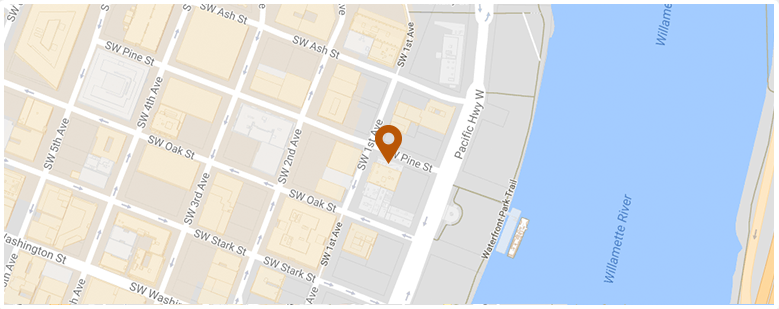
50 SW Pine St 3rd Floor Portland, OR 97204 Telephone: (503) 226-3844 Fax: (503) 943-6670 Email: matthew@mdkaplanlaw.com
map image