"I got into an accident and was nervous about finding a personal injury attorney after hearing so many awful stories, but from the start, I felt confident with my choice in Kaplan Law, LLC." Read More - Ben
"Matt and Gillian took great care of me during a stressful time of my life. Very caring and knowledgeable group. I would definitely recommend Kaplan Law!" Read More - Kayleigh
"Incredible service and results! Matthew Kaplan and his paralegal Gillian did an amazing job for me. Not only did they resolve my case beyond my satisfaction, they also were very caring and supportive thru my recovery. I couldn't ask for a better attorney." Read More - Jamal
Matthew D. Kaplan

A study published earlier this month by the Pew Internet & American Life Project documents what many of us probably knew in our hearts: distracted driving is more than just a teen problem. Following up the Project’s 2009 study of teens and distracted driving, the new report finds that “one in four American adults say they have texted while driving”. In fact, the proportion for adults who acknowledge having engaged in this especially dangerous activity – 27% – is basically the same as the percentage of teens – 26% – who acknowledge doing so.

Perhaps more shocking is the fact that 17% of all adults acknowledge having been so distracted “while talking or texting that they have physically bumped into another person or object” while behind the wheel.

As I have noted in a number of previous posts on Portland distracted driving, Oregon is one of a growing number of states that are attempting to crack down on the practice through legislation. With a small number of exceptions, Oregon distracted driving became illegal throughout the state at the beginning of this year. In a society where, according to the study, 82% of Americans over age 18 now own a cellphone and 58% of them text, distracted driving is likely to continue growing as an issue.
A Supreme Court decision issued today allows an Oregon sexual abuse lawsuit against the Vatican to go forward, raising the possibility that the Catholic Church may have to defend itself in Oregon courts against allegations that it covered up repeated abuse by a priest.

The Oregon child abuse case, officially known as Holy See v John Doe, was brought by an alleged abuse victim. It turns on the actions of Father Andrew Ronan, an Irishman who the church moved from his native country to Chicago and later to Portland as abuse accusations followed him from place to place from the 1950s through the 1980s, according to Associated Press. Ronan died in 1992. The suit’s plaintiff is seeking damages from the church, as Ronan’s employer, for abuse he suffered as a teenager in 1965.

The Vatican, in turn, claims that as a sovereign state it is shielded from such liability under the Foreign Sovereign Immunities Act – a law that prevents individuals from suing foreign countries except in a few, relatively narrow, circumstances. On Monday the Supreme Court turned down the Vatican’s appeal, letting lower court rulings in favor of the plaintiff stand. Those earlier rulings held that the Vatican’s sovereign immunity was not absolute and that the church “could be sued in a U.S. court on certain grounds,” according to the Washington Post.

The Oregon Supreme Court sided with cigarette giant Philip Morris last week in refusing to reinstate a $100 million punitive damage ruling issued by a lower court in 2002. That earlier ruling was overturned by a state appellate court in 2006.

It is important to note that one part of the Oregon product liability and wrongful death case still stands: the original Oregon jury award of more than $164,500 in “economic losses, pain and suffering” is not affected by the ruling regarding punitive damages, according to The Oregonian. Moreover, the Supreme Court ruling does not mean that the case is finished or that punitive damages have been disallowed: merely that the issue of Oregon punitive damages must be reargued before a lower court.

The case concerns a Salem woman who died in 1999 after decades of regular smoking. According to The Oregonian, she switched to low-tar cigarettes in 1976, after a dozen years of smoking, believing that low tar cigarettes would be less problematic for her health. Oregon personal injury attorneys representing the woman’s family argued that Philip Morris possessed study data showing that smokers of low-tar cigarettes tended to inhale longer and more deeply, thus negating the alleged benefits of the product. The company, however, did not disclose this information to consumers.

An enormous recall effort effecting over 2 million baby cribs distributed under the brands of seven different companies was announced this week. The recall action raises issues of liability and responsibility that many Oregon parents would do well to think about in the coming days and weeks.

The recall applies specifically to so-called ‘side-drop’ cribs, in which one of the crib’s long sides is hinged to allow parents easier access to the baby. According to the Consumer Product Safety Commission, the sides of the cribs in question can come loose and drop unexpectedly, creating the danger of trapping children’s heads as they fall. The Associated Press reports that no deaths have been linked to the cribs, but that “at least 16” instances of entrapment have been documented, including one that led to the hospitalization of a child.

The CPSC’s website warns parents not to try to repair the cribs themselves and notes that “new mandatory standards to make cribs safer” are being prepared by the agency. These are expected to be formally issued before the end of this year. The Commission’s website offers links to the manufacturers of the recalled cribs, through which consumers can obtain information on the specific recall procedures for different brands.

A 19 year old Sunriver man is in jail following a weekend Oregon car crash in which he is alleged to have intentionally rammed a police car, according to the Bend Bulletin. The newspaper reports that the final crash came after the alleged perpetrator skipped out on a restaurant check in one establishment, stole beer from another and finally led police on a three-mile high-speed car chase.

The paper reports the suspect intentionally rammed a police car that was trying to get him to stop. The suspect is now in the Klamath County jail following the Oregon car crash. The Bulletin reports that he is being held pending $45,000 bond. The crash occurred on Highway 97 near Bend, according to The Oregonian.

It goes without saying that most of the legal problems this suspect will now face are criminal in nature. The incident, however, is a reminder that Oregon robberies and Oregon car chases that result in car crashes can also create civil liability – issues of fairness and justice which the criminal courts are not necessarily able to address.

The death last year of a patient at the Oregon State Hospital has led to reprimands for five hospital employees. According to the Salem Statesman-Journal a state official and “hospital leaders” decided that reprimands were a sufficient punishment for the five employees. The legal system, however, has yet to have its final say on this serious situation. Oregon wrongful death and Oregon medical neglect lawsuits remain a possibility.

The reprimands were occasioned by the death last fall of 42 year old Moises Perez. Perez died of coronary artery disease, according to The Oregonian, but “lay in his room across from the nurses station for several hours before his body was discovered.”

The paper reports that three nurses and two aides have now had letters of reprimand placed in their personnel files following an investigation by the OSH’s human resources department. The reprimands are not accompanied by any loss of pay or suspension from work. The Oregonian reports that one of the nurses failed to make monthly nursing summaries on Perez’s chart from June until the patient’s death in October. One of the aides was disciplined for failing to alert nurses when Perez did not “show up to take his 3:30pm medications” on the day of his death. A separate investigation of a doctor, being carried out by a medical board, is still under way.

An Oregon car crash this weekend involving a motorist from Washington and a tractor-trailer left the out-of-state driver dead, according to both the Associated Press and The Oregonian. The crash occurred in St. Helens, west of Columbia City and northwest of Portland.

Investigators told The Oregonian they believe the victim, a 44 year old woman from the Seattle area, crossed the center line of US 30 as she was heading north around midday Friday. She collided with an oncoming commercial truck hauling two empty trailers and headed south on the same road. Though airlifted to a Portland area hospital following the Oregon car-truck accident the woman later died.

Oregon truck crashes can be among the most serious of Portland auto accidents. The relative sizes of ordinary cars and large trucks leaves drivers especially vulnerable in the event of an Oregon car and truck accident. In the St. Helens crash, for example, the driver of the truck was uninjured, according to The Oregonian.

As I have noted in a number of previous posts, the new Oregon distracted driving law which came into effect this year allows for “primary enforcement”. That means Oregon police officers can pull drivers over for talking on a handheld cellphone. In some other states, where primary enforcement is not the rule, police must first have noted another offense (speeding, for example, or reckless driving) and may then ticket cellphone use or texting as a secondary, or additional, charge after making the initial traffic stop.

While there is relatively little Oregon distracted driving data available so far (the law has not yet been in force for six months), anecdotal evidence suggests that few of the state’s police departments have made a strong primary enforcement push regarding the distracted driving law.

That, however, may be beginning to change. As the Siuslaw News reports, Florence officials have come to believe that the cellphone ban is not being taken sufficiently seriously. City police issued more than 55 warnings for violations of the Oregon distracted driving law last month alone. The paper quotes the police chief: “That’s way too many for a town our size,” and indicates that officers intend to begin cracking down.

A Portland fatal shooting late last week led to an Oregon death that police describe as accidental, according to The Oregonian. Despite that description, the paper also reports that one person was taken into custody at the scene of the shooting, in Northwest Portland, raising the possibility that an Oregon wrongful death may have occurred.

The newspaper, quoting police sources, reports that police received a 911 call on June 10 indicating that a man had been shot. Arriving at the scene they found the man to be wounded in the chest, but still breathing. He was transported to an area hospital, where he later died. A neighbor told the paper that “she saw the police remove two or three guns” from the house where the shooting took place. The paper reported that homicide detectives has closed off the scene of the shooting and were investigating the precise circumstances of the incident.

One man was reportedly detained at the scene of the incident.

If you arrive in a hospital emergency room unconscious and suffering from an Oregon traumatic brain injury can the doctors use you for a medical experiment without your consent? You might have thought the answer to that question was pretty obvious: absolutely not. According to a recent article in the Portland Tribune, however, you would be wrong.

The Tribune reports that researchers at Oregon Health & Science University, beginning this week, are using a loophole in federal regulations governing medical studies on humans to move ahead with an Oregon brain injury study. Under the so-called “community-wide study exception” the hospital has staged about 20 community meetings to explain its proposed brain injury study and may now presume that any unconscious person brought into the emergency room with an Oregon traumatic brain injury has consented to involvement in the study unless they are wearing a bracelet that declares otherwise, or family members arrive at the ER within one hour of the patient’s admission and refuse to consent to the injured person’s enrollment in the program.

The study in question involves use of progesterone, a hormone that may help severely injured patients recover from brain injuries. It raises, however, a broader question of what ‘informed consent’ ought to mean in the real world. Can an entire community legitimately be said to have agreed to be involved in a study on the basis of a series of public meetings, some of which, according to the paper, were attended by only a handful of people? What about people from elsewhere in Oregon or from out of state who are unlucky enough to be involved in a Portland auto accident and just happen to be taken to OHSU?

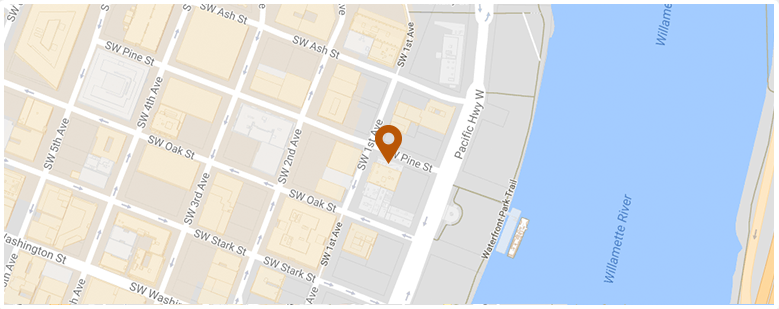
50 SW Pine St 3rd Floor Portland, OR 97204 Telephone: (503) 226-3844 Fax: (503) 943-6670 Email: matthew@mdkaplanlaw.com
map image