Articles Posted in Motor Vehicle Accidents

A recent op-ed piece in The Oregonian raises significant questions about transportation funding and Portland’s streets. Its arguments – whether one agrees with them or not – bear consideration even in a time of tight budgets and, often, cutbacks.

The author, Stephanie Routh, executive director of the Willamette Pedestrian Coalition, argues that the transportation bill passed by Congress earlier this summer falls far short of what is needed to fund improvements to “Portland’s most dangerous streets.”

“Congress didn’t improve on the situation with its new federal funding bill, dramatically reducing dedicated funds for walking and biking safety improvements,” she writes. “The lack of relief for known safety problems may result in preventable deaths of people walking, biking, driving or taking transit for years to come.”

A case that reached a resolution last week in Maryland offers a cautionary tale about dealing with insurance companies, as well as a lesson in the important role media sometimes play in helping victims obtain justice.

According to both Yahoo! News and CNN the story begins in June 2010 when a 24-year-old Maryland woman died in a car accident caused by another driver’s failure to stop at a red light. The driver who caused the crash was either uninsured or underinsured (media accounts vary on this point), but that ought not to have been a problem, since the victim carried uninsured motorist’s coverage as part of her auto insurance package with Progressive, one of the country’s best known car insurance companies.

Under Maryland law a trial was required to establish responsibility for the crash. To the fury of the victim’s family, Progressive’s attorneys helped the driver who caused the crash throughout the proceeding in an effort to establish that the victim was partly at fault – a circumstance that would have allowed the company to refuse to pay on its policy. The company has issued a statement pointing out that it did not formally represent the defendant, but the victim’s brother, quoted by Yahoo! News, said that the insurer’s lawyers repeatedly conferred with and assisted the defendant during the trial. They also made a closing statement claiming that his sister was at fault for the accident. “I am comfortable characterizing this as a legal defense,” he wrote last week, according to Yahoo! News.

A recent article in the New York Times highlighted innovative ways that cyclists are putting technology to use to improve safety. The piece focuses on small cameras that can be mounted on a rider’s helmet. The newspaper describes these as “the cycling equivalent of the black box on an airplane… providing high-tech evidence in what is sometimes an ugly contest between people who ride the roads on two wheels and those who use four.”

Though originally designed for recreational use (the cameras have long been popular with snowboarders and mountain bikers seeking to capture memories of their rides) they are proving useful in urban environments as a way for bike riders to help police pursue and prosecute reckless drivers and to enforce the law in the wake of cycling accidents involving cars. The newspaper notes that use of the cameras has increased markedly as the cost of the cameras has dropped. A good helmet camera can now be purchased for under $200.

“Video from these cameras has begun to play an invaluable role in police investigations of a small number of hit-and-runs and other incidents around the country,” the paper notes, citing local law enforcement. It profiles one New York City rider who was able to help police track down a hit-and-run using video from his helmet camera which captured an image of the driver’s license plate.

A recent announcement by the Hillsboro police department, as reported in The Oregonian, comes as a welcome addition to the summer: the department plans to “have designated officers focused on distracted driving throughout the summer.”

Hillsboro officers working specially designated overtime shifts (funded, the paper notes, by an outside grant) will focus their attention on a broad range of behind-the-wheel distractions. That means that in addition to enforcing violations of Oregon’s distracted driving law, they will also be on the lookout “for people who are distracted by other activities, such as eating and reading.”

“All distractions endanger the driver, passengers and bystanders,” the newspaper quotes a department spokesman saying. Officers, he said, will regularly conduct the extra enforcement patrols between now and September.

A recent article in The Oregonian offered the following somewhat surprising revelation: despite deaths from motorcycle crashes having “more than doubled since the mid-1990s” several major motorcycle-focused lobbying groups are advocating for fewer regulations and less enforcement concerning helmets.

The paper writes that lobbyists and their congressional allies want the National Highway Traffic Safety Administration to be “blocked from providing any more grants to states to conduct highway stops of motorcyclists to check for safety violations such as the wearing of helmets that don’t meet federal standards.”

Even more shockingly, “the rider groups are seeking to preserve what essentially is a gag rule that since 1998 has prevented the agency from advocating safety measures at the state and local levels, including helmet laws.” The article notes that the gag rule is supported both by grassroots-based riders groups and by lobbyists working for motorcycle makers. It is surprising to learn that just 19 states require all motorcycle riders to wear helmets – though also a relief to find that Oregon is one of them. Even more surprising, however, is the revelation that state legislatures have been rolling back helmet laws for years. The article notes that in the late 70s all but three states required everyone on a motorcycle to be wearing a helmet.

Last week a graduating University of Oregon senior was sentenced to three years in prison for the Eugene drunk driving death of a fellow student, according to the Eugene Register-Guard.

The victim, a Scot who was also attending UO, was riding his bike in a marked bike lane when he was struck from behind. The newspaper reports that in the immediate aftermath of the Oregon bike and car accident the 22-year-old driver stayed with the victim “and took responsibility for his conduct.” The driver “had a blood alcohol level about twice that in which a driver is presumed intoxicated under Oregon law,” the paper notes.

The fact that the driver did not leave the scene of the accident and had no prior drunk driving history prompted prosecutors to agree to the lesser charge of criminally negligent homicide, rather than seeking a conviction for second-degree manslaughter (which would have carried a heavier mandatory sentence). The driver pled guilty as part of the agreement with the prosecutor’s office. He will also lose driving privileges for the remainder of his life.

National attention has been focused this week on a Massachusetts teenager convicted on charges of motor vehicle homicide in a case related to distracted driving. The teenager maintained his innocence, claiming he was distracted by worries about his homework load but not by his phone, according to a report by ABC News.

Prosecutors, however, used the 18-year-old’s phone records to prove that he had been sending and receiving text messages moments before his car swerved across the center line, striking an oncoming pick-up truck driven by a “55-year-old father of three.”

If we look at how this case might have played out under the laws in place here in Oregon several noteworthy things spring to mind. The Massachusetts case was a criminal trial. Though there are no reports of alcohol being involved in the crash, here in Oregon a civil case stemming from an accident like this would be similar to a DUII action. Oregon law would allow victims and their families to file claims for medical bills and lost wages and for the loss of the society and companionship of the deceased.

The death of an avid cyclist in a Portland bike and car accident earlier this month has turned a spotlight on bike boxes – the green areas at intersections that the city began adding several years ago in an effort to make Portland more bicycle-friendly.

As I noted last week, a 28-year-old Portland woman died in an Oregon bike accident when she was struck by a semi-truck making a right turn from Madison onto Third Avenue. A recent article on KGW’s website noted that there is a bike box at that intersection, and that accidents like these are exactly what the bike boxes are designed to prevent.

“The green boxes painted in the road with a white bicycle symbol inside are located at several intersections around Portland to help prevent bicycle-car collisions, especially between bikes going straight when cars turn right,” the station reports.

Tragedy struck the Oregon bicycling community this week when a 28-year-old woman died after a Portland bicycle accident in which she was hit by a semi-truck. According to The Oregonian, the Portland truck accident took place last Wednesday evening as “the truck was making a right turn from Madison onto Third Avenue “ when it hit the cyclist, “who was traveling eastbound on Madison,” the newspaper reports.

The cyclist was transported to an area hospital following the accident, but died of her injuries the next day. The newspaper also reports that both police and the Multnomah County District Attorney’s office are investigating the fatal Oregon bike accident.

Accidents like these are the saddest sort of reminder how important road safety is for cyclists and drivers alike. The circumstances of this accident are also telling. A vehicle, especially a large one, is arguably most dangerous to cyclists when it is making a right turn. Drivers are keenly aware of traffic around them when turning left, because this generally involves crossing a stream of oncoming traffic. Right turns, however, are all too easy to think of as essentially ‘safe.’

The Oregonian reports that a Portland auto accident involving a car and a Tri-Met bus recently sent two people to the hospital with what authorities described as “minor injuries.”

Citing a spokesperson for the Portland-area bus service, the newspaper reports that the accident recently occurred “at Southeast 7th Avenue and Southeast Taylor Street. She said the vehicle, carrying three people, is believed to have been traveling at a high speed when the driver failed to stop and struck the bus on its left side.”

Both of the injured people transported to hospital were traveling in the car. The bus driver was not injured and the bus, which was traveling to a Tri-Met garage at the time of the Oregon car and bus accident, was carrying no passengers. That last fact is fortunate: it is likely that the lack of passengers minimized the potential damage from the Portland car crash.

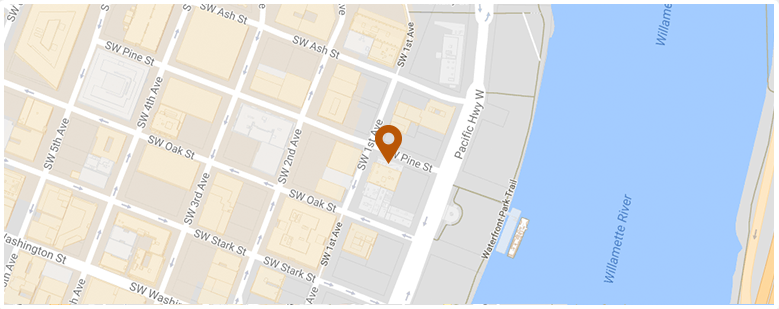
50 SW Pine St 3rd Floor Portland, OR 97204 Telephone: (503) 226-3844 Fax: (503) 943-6670 Email: matthew@mdkaplanlaw.com
map image
Contact Information