"I got into an accident and was nervous about finding a personal injury attorney after hearing so many awful stories, but from the start, I felt confident with my choice in Kaplan Law, LLC." Read More - Ben
"Matt and Gillian took great care of me during a stressful time of my life. Very caring and knowledgeable group. I would definitely recommend Kaplan Law!" Read More - Kayleigh
"Incredible service and results! Matthew Kaplan and his paralegal Gillian did an amazing job for me. Not only did they resolve my case beyond my satisfaction, they also were very caring and supportive thru my recovery. I couldn't ask for a better attorney." Read More - Jamal
Matthew D. Kaplan

The Oregonian reported last week on a sad and solemn vigil held in Portland to commemorate the life, and untimely Oregon pedestrian truck accident death, of a 27-year old woman who lived in the city’s Hayhurst neighborhood.

The woman died earlier this month when she was struck by a truck as she crossed the road at the intersection of the Southwest Beaverton-Hillsdale Highway and Shattuck Road. According to the newspaper she was crossing at a marked crossing place and was doing so with the pedestrian walk signal. The Portland auto accident took place barely a week before Christmas. The vigil, reportedly attended by approximately 25 people, was held two days later.

Addressing the gathering Roger Averbeck of Southwest Neighborhoods Inc’s Transportation Committee said: “This was not an accident. It was a crash, and crashes are preventable,” according to The Oregonian. He called on local residents to advocate for safer, more pedestrian-friendly, streets. The paper goes on to note that in Southwest Portland: “many of the major arterials lack sidewalks, and some have very few places where pedestrians can safely cross. High speed vehicles make travel more dangerous for pedestrians and cyclists.”

A recent news release from SafeKids Oregon – “Concussions: What You Need to Know” – offers an important note of caution during this holiday season, highlighting the dangers of Oregon TBI injuries related to youth sports and offering important pointers for parents who want their kids to be as safe as they are active.

The news release highlights findings presented in a webinar organized by the group earlier this month (see the link below for the press release – which also contains a link to a video of the complete SafeKids presentation). As the SafeKids news release shows, more than a third of all traumatic brain injuries nationwide are caused by falls. Moreover, “more than one in three children who play team sports are injured seriously enough to miss practices or games, and some suffer life-long consequences.”

The report goes on to note that “concussions can happen to children in many activities so knowing how to identify and prevent them is important.” To that end, the webinar points users toward free online training sessions offered by the US Centers for Disease Control and Prevention. One set of videos is aimed at coaches and another (funded jointly by the CDC Foundation and the NFL) targets clinicians with the goal of improving both recognition and initial treatment.

An article published this week in the online magazine Slate makes a compelling case that the Consumer Product Safety Commission, an organization many of us think of as an important guardian of Americans’ safety and rights, could do a lot more to make its own workings transparent.

The article begins with a simple example: “Sometime before October 2011, an unknown child was injured by an unknown product that was produced by an unknown manufacturer. The Consumer Product Safety Commission published a report of the injury in its online database of safety complaints.” It also notes that the unnamed company has so far been able to contest what it views as inaccurate charges that its product is unsafe by filing a secret lawsuit against the CPSC, all the while keeping its name, its product and the allegations against it from being identified in the CPSC database.

Perhaps even more shocking is the revelation that when a federal court in Maryland allowed the secret suit to go forward, accepting the company’s argument that letting people know it was being sued might be bad for business, the government opted not to appeal that decision. According to Slate three consumer-advocate groups have since then been “granted permission to intervene by the court in October (and) are pressing on” with the appeal that the federal government refused to lodge.

An Oregon wrongful death lawsuit filed recently in Chiloquin raises new questions about the conduct of an area children’s center that has had a rocky relationship with state and local authorities.

According to the Klamath Falls Herald & News, the Oregon wrongful death suit against Kleos Children’s Community and the Klamath County Department of Human Services alleges that “a wheelchair-bound 14-year-old placed at Kleos under the directive of DHS died as a result of complications from two bilateral fractures to both femurs” as a result of a November 2010 accident.

The paper and local television station KOBI report that the suit claims that DHS was negligent in placing the child at a facility that, it says, could not properly address his “medical and physical needs.” The newspaper reports that the suit claims that Kleos was negligent in its treatment of the boy – both in initiating the actions that resulted in the accident, and, later, in its treatment of him following the incident. The boy died a day after suffering the two broken legs “when two employees of Kleos dropped him while trying to move him from his wheelchair to a new location.”

An article published last week in The Oregonian’s ‘Hard Drive’ column asked a simple question: if using a cellphone behind the wheel is considered sufficiently dangerous to warrant Oregon’s distracted driving law, what about other potential distractions?

The question was prompted by Washington’s new law legalizing marijuana use. Pot may be legal, but should you be driving with it in your system? If marijuana is going to be legal to consume, should its potential to impair a driver be treated more-or-less the same way that we treat alcohol consumption and driving?

If the answer is ‘yes’ that opens an entirely separate conversation about impairment levels and the best way to measure them. For our purposes, however, the question is broader. As The Oregonian puts it, “whether it’s applying lipstick or reading a book (or flicking ashes from a Camel), trying to micromanage and ban every kind of distraction isn’t the quixotic endeavor that it used to be.”

A single car accident in the early hours of Friday morning is calling attention to the problem of Portland drunk driving and the damage it can cause.

According to a report in The Oregonian, in the early hours of Friday “a gold four-door 1998 Toyota Corolla crashed into the overpass abutment at Northeast 33rd Avenue and Columbia Boulevard, ejecting the 34-year-old driver from the vehicle.” The paper notes that the woman wound up trapped underneath the car. After being rescued she was taken to an area hospital with what were described as “life-threatening injuries.” The newspaper quotes police sources saying that an investigation is still in progress, but that the crash appears to be alcohol-related.

While we can take some small consolation from the fact that this terrible accident involved only a single car, it also serves as a powerful reminder of the damage drunk driving can do – a reminder that is especially timely as we enter the heart of the Holiday Season. The period between Thanksgiving and the New Year is always filled with parties, visits to and from relatives and many, many opportunities to overindulge.

Now that Thanksgiving is over and Christmas, Hanukkah and the New Year are fast approaching it is a good time to remember that holiday joy should also be tempered with a measure of caution. Earlier this month the US Public Interest Research Group released its annual survey of dangerous toys, Trouble in Toyland. It is a reminder that parents need to take care during the coming weeks to ensure that unsafe products do not threaten their families.

The issue here is not so much the common dangers that any responsible parent is always aware of – choking hazards, for example (though, to be clear, these remain very real). Rather it is with manufacturing problems that parents may not immediately be able to see, but which pose a risk of death or serious injury to unsuspecting children.

Trouble in Toyland notes that “toys with high levels of toxic substances are still on store shelves, as well as toys with lead content above the 100 parts per million limit.” It also expresses particular concern about toys containing “small powerful magnets that pose a dangerous threat to children if swallowed.”

An article published yesterday in the New York Times raises serious questions about product safety issues concerning bed rails, and is worth our notice here in Oregon. The paper’s reporting is built around the shocking revelation that the Consumer Product Safety Commission and the Food and Drug Administration have both “known for more than a decade about deaths from bed rails but had done little to crack down on the companies that make them.”

Even the fact that two government agencies had so much evidence raising questions about these dangerous products came to light only after a woman whose mother died in a bed rail accident launched a persistent letter-writing campaign. The woman became concerned about safety issues after her 81-year old mother died when she was “apparently strangled after getting her neck caught in side rails used to prevent her from rolling out of bed” at the nursing home where she lived.

The newspaper reports that data compiled by the CPSC documented 150 adult deaths, mainly among senior citizens, as a result of bed rails between 2003 and mid-2012. “Over the same time period, 36,000 mostly older adults – about 4,000 a year – were treated in emergency rooms with bed rail injuries,” the Times adds.

We’ve all seen the tiny red and yellow bottles in the supermarket. Most of us have seen the TV commercials too: 5-Hour Energy bills itself as an afternoon pick-me-up for flagging office workers, and as time-efficient replacement for a late commuter’s morning coffee.

According to an investigation by the New York Times, however, information compiled by the federal government raises important questions about the safety of 5-Hour Energy and similar products. “Since 2009, 5-Hour Energy has been mentioned in some 90 filings with the FDA, including more than 30 that involved serious or life-threatening injuries like heart attacks, convulsions and, in one case, a spontaneous abortion” the newspaper reports.

The paper notes that the mention of a product in an FDA filing does not necessarily mean that the product is connected with a particular incident – only that a connection is possible or suspected. Still, the Times reports that 13 fatality reports mention 5-Hour Energy and that the government, as a result, is concerned. The Times adds that the regulatory world concerning energy drinks is often confusing because some are treated as beverages while others (including 5-Hour Energy) are classified as dietary supplements. Each category has different rules regarding both labeling and whether and how adverse events need to be reported to the government. The article quotes an FDA official saying that the reports are prompting a closer examination by the Agency.

Following up a story I originally wrote about last month, there are new developments in the death of an 11-year-old Portland girl in a September accident involving a party bus.

According to The Oregonian the girl died when her skull was crushed as she “tumbled out of an emergency window on the bus when it careened around a corner… at Southwest First Avenue and Harrison Street.” She is reported to have been sitting atop a horseshoe-shaped couch in the back of the bus at the time of the fatal Portland bus accident. “The bus was full of kids on their way to a birthday party but no adults were in the back,” the newspaper reports.

As troubling as this lack of adult supervision is the revelation that the bus itself lacked the proper safety inspection permit and was being operated by a man who was not licensed to drive this type of vehicle, according to The Oregonian. This image of a company putting immediate profits ahead of safety is chilling not only for any parent considering whether to let a child attend a party involving this sort of bus but, frankly, for any adult who might be thinking of hiring a party bus for a special celebration. The fact that a window that was supposed to function as an emergency exit flew open so easily is a reminder of how essential the required government safety inspections are.

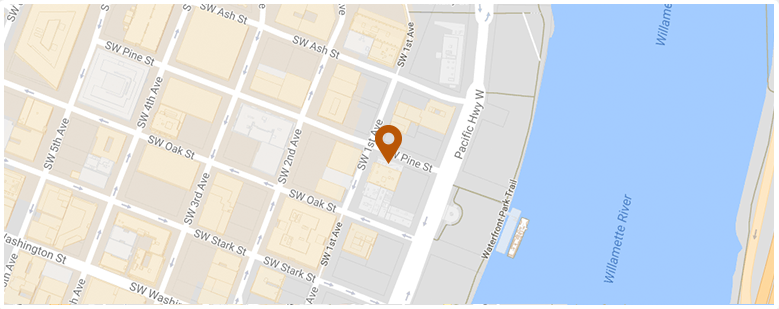
50 SW Pine St 3rd Floor Portland, OR 97204 Telephone: (503) 226-3844 Fax: (503) 943-6670 Email: matthew@mdkaplanlaw.com
map image